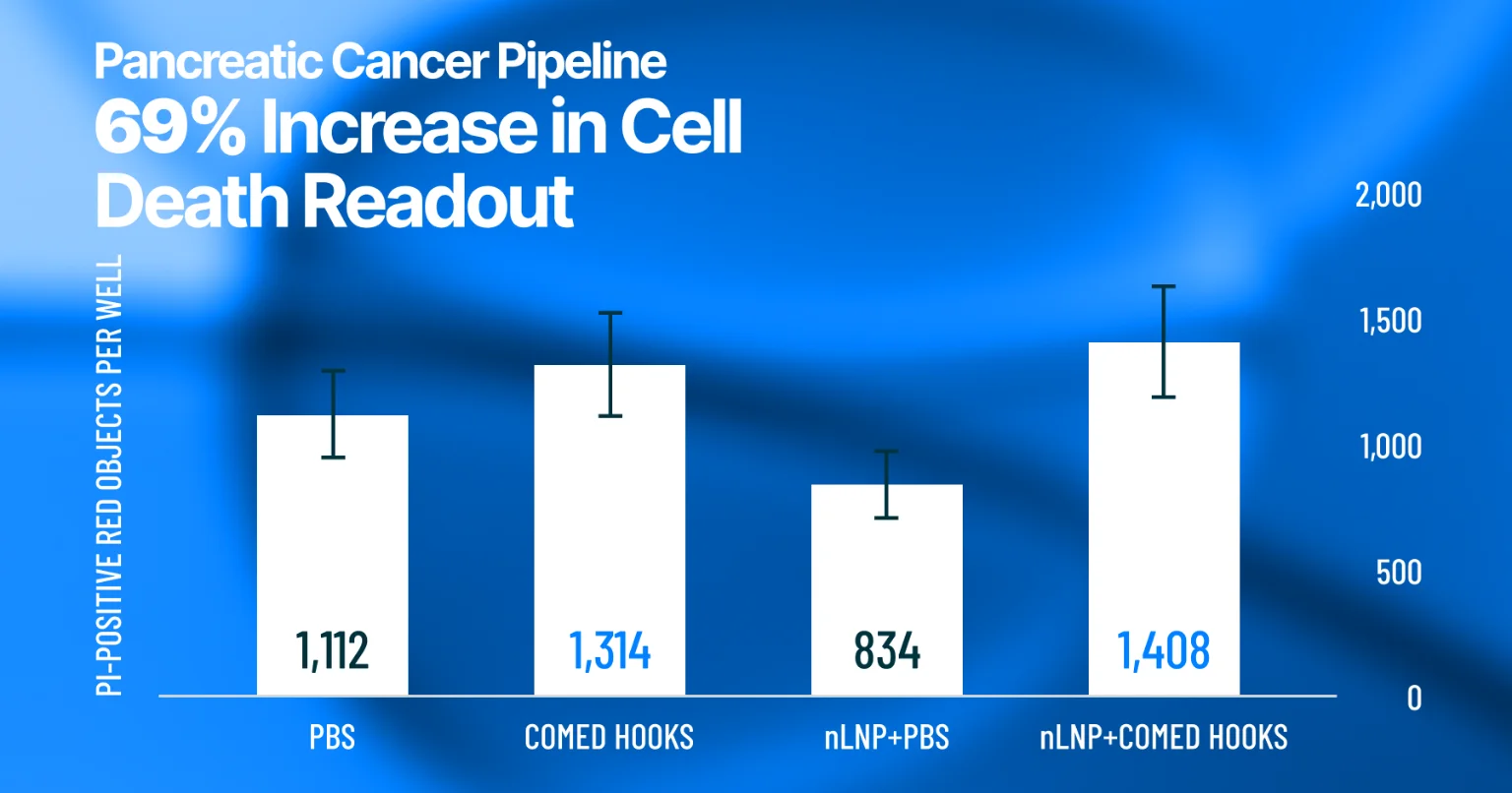
As a new update from our Pancreatic Cancer Program, an independent proliferation study in CAPAN-2 pancreatic cancer cells has produced a clear phenotypic finding: treatment with COMED Hooks increased the number of PI-positive objects by approximately 69% compared with the matched natural lipid nanoparticle (nLNP) control.
Propidium iodide (PI) identifies cells that have lost membrane integrity, providing a readout associated with cell death and dying cells. In this experiment, the matched nLNP control yielded 834.4 PI-positive objects, compared with 1,407.9 following treatment with COMED Hooks—a 68.7% increase.
This result adds an important functional layer to our previous proteomic findings, which indicated that residual CAPAN-2 cells had moved away from highly proliferative and anabolic programs and exhibited substantial metabolic stress and biological vulnerability.
The PI findings are consistent with those molecular observations and provide independent phenotypic evidence of increased cell death following treatment with COMED Hooks. Further functional studies will be needed to establish the underlying mechanism and determine the nature and durability of this response.
One dataset shows a molecular change. A second, independent readout now shows a corresponding cellular effect. That convergence is what makes this result particularly important for the continued development of our Pancreatic Cancer Program.